An Arab actor and a Jewish journalist sense social upheaval and search for a place where they can belong. Ophir Award Winner for Best Documentary.
Archives
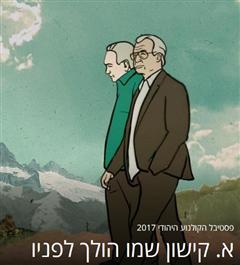
Kishon
During 50 years of writing Ephraim Kishon sold millions of books and won two Golden Globes, yet he could never write his own biography. At the age of 70 he invited journalist Yaron London to assist him. “KISHON” uses animation to ‘bring back to life’ Kishon’s persona and reenact the rare dialog.
Fire Lines
Fire Lines tells the story of the Palestinian and Israeli firefighters who join forces to battle the historic Mount Carmel forest fire of December 2010.

9 Star Hotel
Slipping through the predawn darkness over highways, through traffic and across the border, Palestinian construction workers go to work clandestinely in Israel every day. Haar’s raw, handheld photography follows workers who build their own border shanty community to enter Israel more easily, with no choice but to risk their lives simply to earn a living
Shout
A rare look into Palestinian life in contemporary Syria. Born on the Golan Heights, best friends Ezat and Bayan go on a journey to study in Syria. What starts out as an adventure to an unknown homeland leads to a search of identity and belonging.
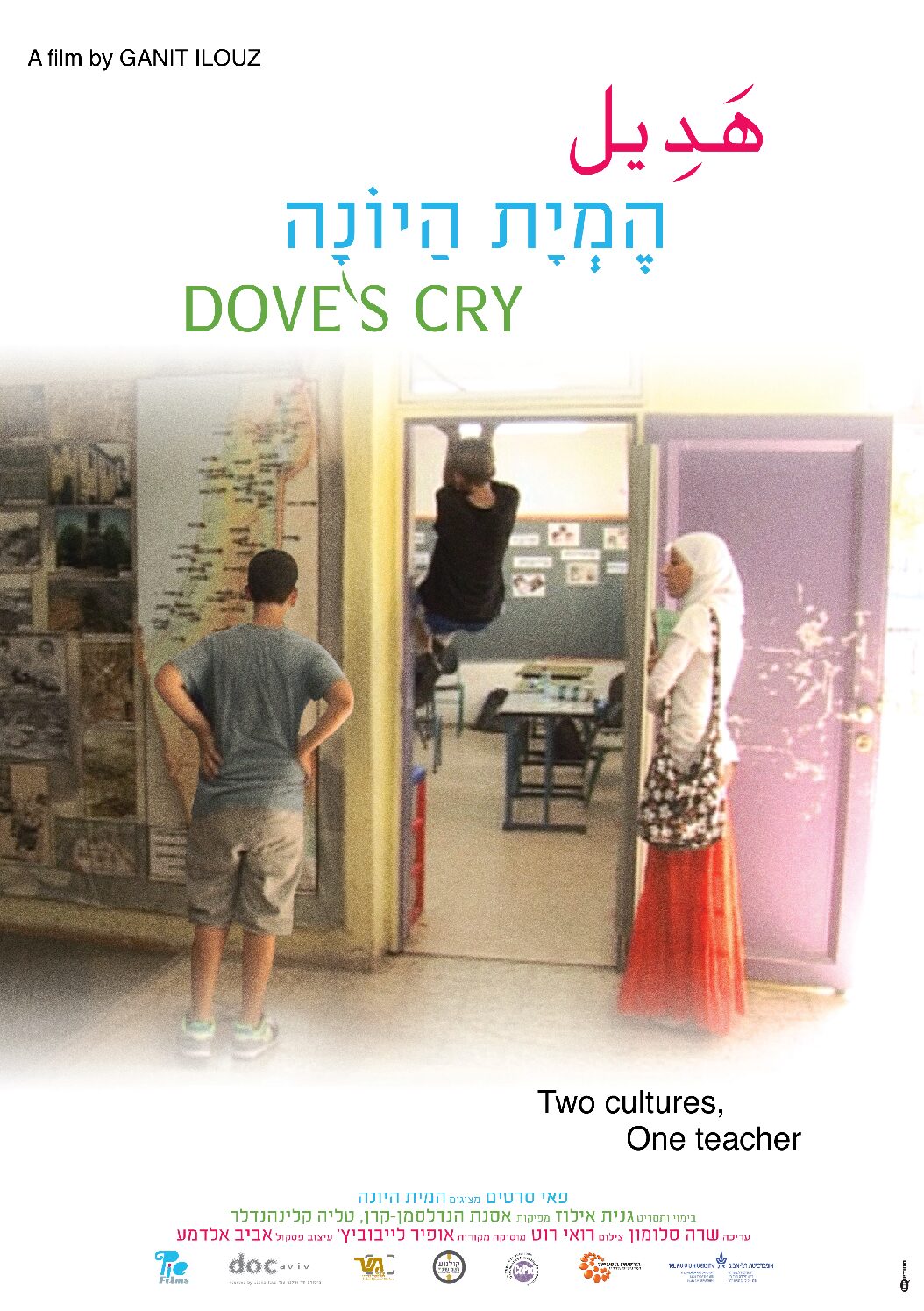
Dove’s Cry
Hadeel, a charismatic Arab teacher, teaches Arabic in a Jewish elementary school. Her relationships with the pupils and staff enable both parties to have a unique glance at one another’s cultures, refute prejudices and dissolve fears. Yet, due to the complex Israeli reality, the meeting of these two cultures inevitably causes clashes. Back home, being 27 and a religious Muslim woman, Hadeel is being pressured to get married this year.
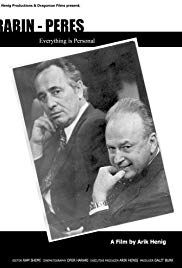
Rabin-Peres: Everything is Personal
Shimon Peres and the late Yitzhak Rabin are undoubtedly the most riveting political duo in the state of Israel. Their relationship knew many ups and downs, mainly downs resulting from the polar differences between the two. One was Israeli born, a prince and general, while the other was a new immigrant, a greenhorn that never lost the foreign mannerisms and accent, until this very day. One was admired, loved by the public, while the other never succeeded at the voting booths, not even once!
Director Arik Henig has served as a journalist and documentarian for the past 25 years , as well as media and political advisor to some of Israel’s prominent leaders. This insider’s access, along with his long professional and personal relationship with Rabin, allowed Henig to create a unique and fascinating portrait of the two legendary Israeli leaders, whose actions and leadership still impact the tumultuous situation of the Middle East.
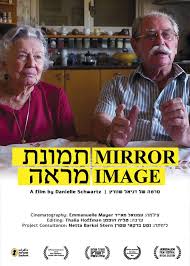
Mirror Image
In a pastoral house on the Israeli countryside live the filmmaker’s grandfather, grandmother, and a big crystal mirror that was taken from a Palestinian house during the Nakba – the depopulation of hundreds of thousand of Palestinians during and after the establishment of the state of Israel in the 1948 war. The story of the mirror is not a secret, but it remains untold. The filmmaker asks why is it that Jewish Israelis cannot address the mirror and others remnants of the Nakba, even when they are placed in the center of their lives? In this short conversation, the filmmaker and her grandparents negotiate the ways to tell the untold, staging an allegory for the position the Nakba takes in the realities of Israeli Jews.
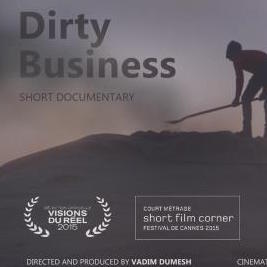
Dirty Business
Dirty Business follows the traditional coal industry scattered around Israel and the West Bank and sheds light on economic relations between the two sides.
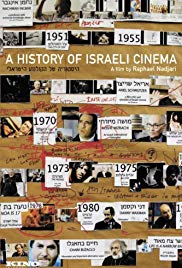
A History of Israeli Cinema (Part 2)
A History of Israeli Cinema tells the story of the building of a gaze on a society torn by ethnics, religious, and political conflicts. It attempts to understand, to denounce or to explore these complex subjects, always searching for the right ethic, the right form: to explore or transform its own definition and its place in the world. A History of Israeli Cinema is the result of years of research, studies, documentation, screening, interviews, some recorded, some to learn, to understand, to unfold. Actors, thinkers, producers, filmmakers, professors, critics negotiated to build a narrative that remains fragile and incomplete. It is the process rather than the result that is shared here. The first episode (1933 – 1978) starts with the Zionist movement and ends with the first re-visitation of that history. The second episode (1978 – 2005) starts at the beginning of the political wave until the more recent personal cinema. However chronological, both episodes cover most of the genres, themes and periods of Israeli cinema—from the beginning of the Zionist Movement to the most personal stories—from commercial to politically engaged directors, from the local to the universal.
Watch Part 1 here.