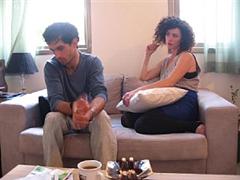
Identity, family, and ethnicity blur in surprising ways in Noa Ben-Hagai’s Blood Relation. Ben-Hagai discovered letters from her great-aunt Pnina and learned that in the 1940s, 14-year-old Pnina disappeared near her family home in what is now Israel. While initially the family didn’t know what happened to her, Pnina’s letters revealed that she married an Arab and had children with him-though it is never completely clear if this was by choice or not-and now lives in a refugee camp as an Arab. The letters also contained Pnina’s desperate pleas for contact from her family. With the help of her uncle, a retired colonel in Israeli intelligence, Ben-Hagai tracks down the unknown family in the Palestinian Territories, and uncovers a singular history of the Israeli-Palestinian divide. As the families reunite, their divergent positions and rights as Israelis and Palestinians place an immediate strain on their relationship. Skillfully weaving archival footage and photos together with family interviews and scenes from various meetings of this Jewish-Arab clan over the course of three years, Blood Relation provides a uniquely personal example of the complexities of Israeli-Palestinian reconciliation.
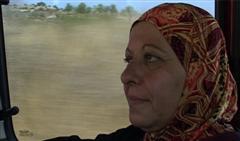
The final and most controversial part in Haim Yavin’s travelogue, examining different aspects of daily lives and struggles facing Arab citizens in Israeli society.
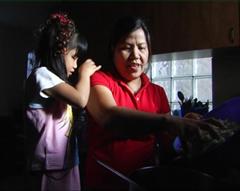
A six-year-old Filipino girl who is blind and was born in Israel is adopted by a loving Filipino worker, Janet, a Philippine foreign worker. Janet needs to explain to her daughter about an operation which might save one of her eyes and increase their chances to stay in Israel. Together they try to bridge linguistic and cultural gaps in a country that one of them regards as her homeland, while the other considers it a foreign land.
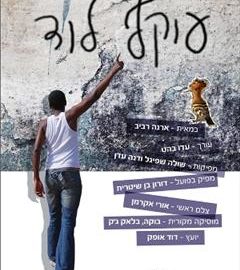
The story of Ilan Hakaray, principal of the Amal High School in Lod who offers students their last opportunity to complete a high school education after they fail out of other institutions. We follow three students’ stories through their principal’s eyes, as he doggedly fights for them to succeed against all odds.
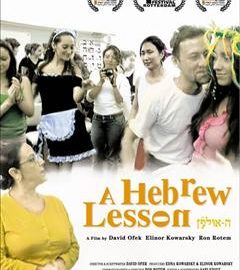
A Hebrew Lesson is a humorous, smart and exciting mosaic of a mixture of immigrants of various nationalities and their teacher. It is a film that gets under the skin of its participants as well as that of the audience. One of those whose characters won’t let you go even days after having seen it – and actually you don’t want them to leave. Chin left her daughter in China and came to Israel to make a living there. She cleaned Ehud’s house, and they fell in love. Sasha never considered immigrating to Israel. But four years after his wife left Russia with their daughter, he understood that life without his child would be worthless. He abandoned a thriving business, only to find himself in Tel Aviv’s worst neighborhood. Marisol grew up as a Jewish princess in Lima, Peru and came to Israel to learn something about life. An unplanned pregnancy alters her plans. These and other characters meet in a Hebrew language Ulpan, where their personal stories melt with the complexities of Israeli reality. The immense effort of learning a new language is revealed through their encounter with a strange culture and an unfamiliar environment. Israeli society is revealed through the foreigner’s eyes. This gaze – at times funny, at times sad – paints daily reality with irony. But beyond the obvious differences, the human common denominator of longing and love triumphs time and again.
This film is an excellent vehicle to explore issues of Jewish identity. Orthodox Jews, Jewish atheists, Russian immigrants, and kibbutzniks discuss their views on the controversial debate over “who is a Jew.” Interviewees featured in the film include Abba Eban, Rabbi Goren, Yigal Alon, and David Ben-Gurion.
Miriam El Kwader, a Bedouin wedding photographer and mother of seven, living in an unknown and neglected Negev village, reveals through her camera lens, the world of Bedouin weddings; the most distressing issue revealed is polygamy.
This is the story of three, relatively educated and independent women, trying to survive, each in their own way in their world – a life of polygamy. One is a “first wife”, living in constant fear that her husband will bring home a second wife. The other two are pushed into marrying already married men, and become “second wives”, forced to cooperate within a structure they despise or are afraid of.
The family tragedies presented in this film, highlight the strength and survival of the social structures and their injustices; leaning usually on the victims` partial cooperation.